“Nobody wants to remember trauma. In that regard society is no different from the victims themselves. We all want to live in a world that is safe, manageable, and predictable, and victims remind us that this is not always the case. In order to understand trauma, we have to overcome our natural reluctance to confront that reality and cultivate the courage to listen to the testimonies of survivors.”
- Bessel van der Kolk, The Body Keeps the Score
Introduction
This is the story, so far, of my vaccine injury and the wider context in which it occurred. For those of you who don't know me, I'm a regular guy currently living in Brisbane, Australia. I'm married with two kids, and work as a software engineer (and am also a self-published author).
It's taken me a long time to write this up for several reasons, including:
- I know the act of writing this is going to be emotional and trigger a certain amount of PTSD. To be quite honest, I'm not sure I'm ready for it until I try.
- I simply haven't had the energy or time. From my injury until now, any spare time I've had has gone into recovery-related activities, which often means doing as little as possible.
- I was afraid of talking about this publicly due to the ongoing stigma around vaccine injury, and the barbarous vilification of the vaccine injured.
- The format of my blog has long been that of presenting a problem followed by one or more solutions. Given that no one has any comprehensive solutions yet, let alone me, it has left me feeling that writing about this might be anticlimactic (if you're vaccine injured, don't lose heart at this statement - please read on to see if you can relate and take what you can from my experience).
I am convinced that now is the right time because:
- I realised that talking about my vaccine injury is part of the solution.
- I am now well enough that I have time and energy outside of work to actually invest in this (that said, it has taken me months to write this).
- The more I have learned about my condition (of which, read on), the more I think this will be therapeutic. Indeed, I'm treating this exercise as an important part of my recovery.
- I am a litigant in a class action against the TGA and it will help me having this all written down.
Anyone who knows me will be aware that I don't do things by halves. True to form, I have decided to give a full accounting of my story here, including things from long ago that may not immediately seem connected. Feel free to skip or skim sections if you do not think them relevant, but I would encourage you to read everything, since I have made no accommodations for skipping. Besides, you may unexpectedly find something to be relevant to your own circumstances.
I plan on updating this account as my journey continues to unfold. Each update will appear as a separate post. There are feed links at the bottom of the page if you wish to subscribe with an RSS reader.
Commentary outside the main narrative will appear like this, as a block quote.
To avoid censorship of my entire blog, I am hosting this content independently. It's still possible it will be taken down, but if that happens I will host it elsewhere using the same domain. Worst case scenario, I end up putting it on a substack or even host it myself.
Notes to the Audience
When I first set out writing this account, it was my sincere hope that I would have solid and reproducible recovery advice for those whose vaccine injury is similar in nature to mine (from what I've been able to ascertain, there are at least three patterns of injury). Whilst that is not yet the case, I do have a huge level of confidence that I have identified what needs to be addressed, despite still being in the process of addressing it.
From all the personal stories I've consumed via social media and other uncensored media sources, there are a great deal of people whose injuries look like mine. If you're injured and are looking for recovery advice, please consider reading my account and synthesising associations with your own life and experience. If you resonate with what I'm saying, I'd strongly recommend delving into the resources I list at the end.
It's also possible you may be injured but have not yet implicated the vaccine. Perhaps someone you know suggested reading this post in an attempt to open you to the possibility. As you'll read below, it took me quite some time to realise and accept that the vaccine was the catalyst. Being harmed by something that we've been assured is safe, was supposedly going to restore society to normality, then being told we're imagining or misattributing that harm, is an awful lot for the human pysche to take in. A reticence to do so is not a character flaw or personal failing; it's a psychological protective mechanism. Take whatever time you need.
If you're not vaccine injured but want to get a sense of what it's like, thank you for exhibiting the empathy we so desperately need. I hope my account does some justice to the experience. However, I reiterate that there appear to be multiple presentations of injury, and I can only describe my own. From what I can tell, it seems to be the most common pattern.
Long-term Health History
I grew up mostly in Adelaide, South Australia. As a child and youth, I was inordinately healthy. In large part I owe this to my mother, who understood the importance of good nutrition, exercise, and sleep. I was also very fortunate to have a wonderful friendship with my late brother, Mark, with whom I spent countless hours playing sports, walking our dog, or just goofing around. And when I wasn't hanging out with Mark, I was often with school friends, playing basketball, doing karate, cricket, or whatever physical pursuit I was drawn to at the time.
When it came to illness, I rarely got sick and quickly bounced back when I did. The school I started attending in sixth grade gave an annual award to students with perfect attendance. I received that award every year of my schooling there apart from grade 12, thanks to a couple of days laid up with some kind of virus (I was not happy that my perfect streak had come to a premature end).
I really was a picture of health.
On the 11th of December, 1998, I was struck down by illness. I had moved out of home around 6 months earlier, and I became so ill that my mum took me back to her house to look after me. She took me to a doctor, who said I had glandular fever and should rest.
If you're wondering how I recall the exact date I fell ill, I was stoked to be able to figure it out with a bit of sleuthing.
The night I fell sick, I happened to be at a Powderfinger concert with a friend of mine, my brother Mark, and my future wife Belinda. I recall having to work my way to the back of the venue, sitting down in a bit of empty space nearby to where drinks were being served. I became increasingly ill as the night went on, trying to enjoy the music as best I could, but finding it more and more difficult to do anything other than sit with my head resting on my legs.
I managed to find the details of the gig online, and therefore the exact date. Look at that setlist! Fortunately, I saw Powderfinger a couple more times after that.
But Mum, being a nurse, knew something wasn't quite right based on my symptoms, and she sought a second opinion. So off to another doctor we went, who diagnosed me with tonsillitis and prescribed antibiotics. I don't recall how many times we went back and forth between these doctors, but eventually they stopped assuming the other doctor was wrong, and came to the realisation that both were right: I had both glandular fever and tonsillitis. As a result, I took antibiotics and was in bed resting for a solid two weeks before emerging.
The antibiotics would have wiped out my gut microbiome, leaving me vulnerable to whichever bacteria managed to take a foothold. Given that I had moved out of home, my diet was not as it once was (I was very much just learning to cook and was quite ignorant regarding nutrition). Moreover, I don't believe I was given probiotics, which I now know to be very important when taking antibiotics. I rather suspect this was a factor in what was to come.
I returned home and to work (I was working at Mitre 10 whilst studying) as soon as I could. My colleagues were a little shocked at my appearance. I was gaunt and pale, at least for a week or two more as my body continued to recover.
My early return to work was likely another important factor in my story. It wasn't well understood at the time, least of all by me, that adequate rest is of paramount importance after viral infection, especially EBV and certain other viruses (yes, including that virus). And “adequate” can mean over-resting to be certain of recovery before asking anything significant of your body.
Life continued on as normal, or so I thought. I moved again, this time into a small, second-story apartment. I landed my first job in IT, for which I will be forever grateful.
One evening when returning from work, I happened upon a curious scene: my door was busted open and firefighters were mopping up water. My heart leapt into my throat as I wondered what I'd done, but I was promptly told that my neighbour had left their bath tap running when they went out. Thanks to a slight slope in the building, the result was water running almost directly from their second-floor apartment into mine, since the bathrooms were right near the front doors.
Knowing absolutely nothing about water damage or mould, I thought very little of it. After all, the water had only been around five or six centimetres deep (about two inches) and the firefighters hadn't warned me of any possible repercussions. I didn't even take anything outside to dry because nothing was directly on the floor. I just made sure to mop the floors extra carefully and that was that.
I lived in that apartment for at least another year or so. I was very clean, but I do wonder whether the water damage encouraged non-visible or subtle mould to sprout and act as a sensitizing event, making me more reactive to future mould exposures.
At the same apartment, my car was frequently broken into it. Once the thieves realised I didn't store anything of value in it, they took to vandalism. This included tipping radiator water all over the interior. That may also have contributed to mould exposure.
It was a year or two later that I finally admitted to myself that I still hadn't fully recovered from my bout of glandular fever. I wasn't terrible, but my energy levels seemed to be significantly impaired. At that point I was still able to play social basketball here and there, but was finding I was very flat the day or so following.
So began my spiral into worsening health, and my journey into discovering the inadequacies of western medicine when it comes to chronic conditions.
My first doctor's visit specifically regarding my poor energy was a couple of years later, sometime around 2003, by which point I was married to Belinda, and living with her our new home. The GP I saw helpfully advised that I “eat more vegetables,” despite not asking how many I was eating (plenty). This put me off seeking further help from him, and unfortunately I was not yet worldly enough to seek help elsewhere.
In 2004 I had my first child, Tempany. She added a wonderful and joyous extra dimension to my life, but I began to notice my inability to be as involved as I'd have liked. Things just took too much out of me.
In 2006 I accepted a full-time role with a company I had previously contracted for in 2004, and it came with a curious condition of employment. I needed to pass a medical check-up. For a desk job! This stipulation was added because, during my earlier contract, I had taken quite a few days off unwell. In that period I was really struggling with energy and fortitude (I was mildly depressed). The funny thing was, I really looked forward to the check-up, excited at the prospect of them figuring out what was wrong with me. I even risked the job by letting them in on my recent struggles, hoping they'd put two and two together with their observations, and provide me with an avenue for recovery.
For those who don't know me, it's worth a quick aside to let you know that I've always had the “curse” of looking well. I'm athletic in build, around 6' 3", have never been overweight, never smoked, and rarely drink. Visually, there was no reason to think that I needed a medical. Being assumed healthy just because you look it is a common complaint of the chronically ill.
(Un)fortunately, I passed the medical with flying colours and took the role on for 14 months, which I greatly enjoyed. What's incredible to me is that I took advantage of the company gym during that time (nothing too strenuous, a combination of cardio and free weights), and although I felt very exhausted after my sessions - sometimes to a worrying extreme where I would struggle to move my arms - I didn't need many sick days at all.
I retrospectively understand this as evidence that it wasn't purely physical stress that was impacting me, but overall stress. After all, just a couple of years earlier, I had worked not ten metres from where I was sitting, earning significantly more as a contractor, wasn't taking on additional physical stress by working out, and yet there I was feeling a lot better in my new role.
I have come to learn that stress is far more nuanced than I thought. It's highly individualised (I find some things stressful that you wouldn't, and vice-versa), highly contextual (I find some programming tasks therapeutic and others highly stressful), multifaceted (physical, emotional, social, psychological etc.), cumulative, and often downright insidious in nature (“hidden” stressors such as mould, chemicals, and other toxins adding to our overall load).
Back then I hated my job, but now I genuinely enjoyed the challenges I faced and the technologies I was working with. This made a world of difference to my overall ability to function, though I still was nowhere near where I felt I should be.
In 2007 we moved to London, England. I took the opportunity to again seek assistance regarding my poor energy, naively supposing that doctors in London might generally be more insightful than those I had seen in Australia. I went to at least two more GPs. I cannot recall the specific advice of the first, only that it involved a coming to Jesus. The second ran some bloods, found nothing abnormal, and declared that I must therefore be healthy. Stellar!
Again, this experience put a large dent in my enthusiasm for seeking help. I still thought of western medicine as the pinnacle of health wisdom, even if my confidence in individual GPs was waning. Therefore, the conclusion I was slowly arriving at was that I was the problem. I wasn't trying hard enough. I just needed to push through it. Given enough exercise, I would come good and my energy levels would increase.
Bad idea.
By now it was 2008, and I took up intensive gym training (mostly fixed weights), ignoring the dizziness, shortness of breath, and my very low reservoir of energy. I would push through my sets and head back to work, where I could slump at my desk, resting my weary body. The following evening (yes, not the same evening), I would be struck down with the most intense vertigo, forced to lie flat on my back for fifteen minutes or more. I was also extremely low energy, finding things as simple as short walks to be draining.
Over the next year or so, I doubled-down on my stupidity by developing more and more bad habits, just trying to spark some energy. My diet deteroriated as I consumed more and more sugary junk and caffeine. Unfortunately, it worked - for an hour or two I would feel more energised after eating crap. This encouraged more of the same behaviour, but it became less and less effective over time.
By mid 2010 I was literally falling asleep at my desk at work. I have no idea how I wasn't fired. Once a day, I would head to the toilets just so I could sit and sleep for fifteen minutes or so. My reality became more and more surreal - everything felt hazy. My morning trips into work were a case of one foot in front of the other, with an ever-narrowing tunnel vision that blocked out anything it could in order to reduce stimuli. It felt inevitable that my body would give out at any moment.
And finally it did.
It was the Christmas holidays of 2010. I had landed a new job and was looking forward to starting in January. My previous job had been terrible, whether I was awake or not. Moreover, my new job allowed me to work from home for one day a week, and I knew instinctively that this would offer some reprieve from much of the stress I was experiencing.
One Friday night I awoke with horrible neurological symptoms. I won't go into too much detail because it's quite personal, but suffice to say that my body started torturing me - and I use that word very intentionally - every moment of the day.
I had intense, deeply uncomfortable and distressing symptoms that were punctuated every one to two seconds with even greater pulsations. Sleep was a cycle of losing consciousness from sheer exhaustion, only to be woken again a second or two later by my symptoms. My every conscious moment was misery. And just like torture, I had no hope of cessation.
After two weeks of this hell, I was crying in Belinda's arms, giving her a date by which I needed it to end, one way or another. Twelve months.
My Christmas holidays ended and I started my new job.
I have no idea why, or how, I went to work at all, let alone a new job. My symptoms hadn't improved one bit. But in a strange way, it helped. Being in the state I was, I certainly didn't make any friends at my new workplace, but I was tasked with genuinely interesting work that acted as something of a distraction from my symptoms. It was like I was meditating on work rather than on my body. I was able to focus in on the problem at hand, blotting out everything else, narrowing my conscious experience so that I resided only in my head, pushing aside my body's afflictions.
I went back and saw the same GP who had given me a clean bill of health. I had seen him six or seven times by this point, all within a relatively short period of time. He ran tests again, and once again they came back OK. He looked at me and said that he thought I might be a hypochondriac.
Within a couple of weeks, I had developed an infection right where you least want one. The same GP prescribed me antibiotics, which quickly cleared it up. For a week or two. I was then struck by a second infection, and could you imagine the look on my GP's face when I told him. He was hesitant to order the test, but in the end he did. When it came back positive to another infection, he looked at me and, without apology, said “OK, maybe there is something going on here.” Luckily for him, I am not a violent man…
In desperation I had posted online in a chiropractic forum, since I suspected the problem might be spine related. I didn't have great posture and my symptoms were neurological, so it seemed plausible to me. Someone responded that it might be worth seeing a Dr Heidi Grant, an upper cervical care specialist. I did just that.
With one correction to my atlas, my symptoms dissipated within minutes. I was so astounded, I didn't dare believe it to be true. And yet, there I was, sitting on the tube ride home, for the first time in weeks, able to just be present without my body torturing me. I smiled involuntarily, which I think might be a finable offence on the tube.
Alas, the relief provided by these corrections did not last long. For a day or three, I would feel significantly better - sometimes completely so - but then my symptoms would come right back. I'd go and get another correction, and the same pattern would repeat. Over time they became less effective, both in their alleviation of my symptoms and in their longevity, which was incredibly distressing for me to acknowledge.
Fortunately, Heidi's knowledge wasn't restricted to her field alone. She asked me questions about gut health and was quick to recognize that I was likely suffering from leaky guy (largely ridiculed at the time by western medicine, but now readily accepted under the term “intenstinal permiability”). Heidi referred me to a nutritionist, Hannah Richards, whom I went to see not long after.
Hannah whipped my nutrition into shape on the basis of metabolic testing, microbiome testing, and some other diagnostics. It was very hard at first, due to it being so strict and alien. Following her advice, my gut function seemed to improve and, along with that, my symptoms also. It was not a fast process, nor was it linear, but over the following three years or so I extricated myself from the hole I had slowly dug the decade prior.
Hannah and Heidi saved my life. And they were my first experience with health practitioners outside of the standard, government-endorsed health system. But still I didn't really have a diagnosis, or any real understanding of what was wrong with me. I felt like I had come an awful long way from where I was, but in reality I was still a shadow of my younger self.
In 2013 we returned from London to Adelaide because Mark had been diagnosed with cancer (multiple myeloma). I initially returned ahead of my family and lived with Mark. We talked a lot about our respective health issues. Mark suggested seeing his GP, so I did exactly that. She was lovely, but said it was beyond her ability to help me. What really struck me was the admission of ignorance rather than the façade of wisdom. It was the first time I'd experienced this across all the medical doctors I'd seen.
Around a year after my family returned, we moved about 30 minutes from Mark's place to another area we had never previously lived in. I tried the local GP there, too. He focused the conversation on how I was feeling. I answered honestly: that I was finding it hard to be happy (no doubt Mark's plight had a part of this, but also that I knew something wasn't right with me and no one seemed able to help). He told me that I had a lovely wife, great kids, and a good job, so I should be happy. Simple! He offered me anti-depressants, which I refused. I walked out, reluctantly paid the Medicare “gap”, and never returned.
In 2015, through machinations I don't recall, I ended up seeing another GP quite some distance from my home.
This particular GP specialized in ME/CFS (Myalgic Encephalomyelitis/Chronic Fatigue Syndrome; two different names for the same thing, normally referred to as CFS in Australia), so I must have had an inkling by that point that I “had it”, without really understanding what “it” was.
After taking my history and running some tests, she diagnosed me with CFS. But this wasn't the victory I thought it might be. CFS is diagnosed by exclusion, which essentially means it's a shrug of the shoulders - nothing else explained my long-term fatigue and post-exertional malaise, therefore it must be CFS! Moreover, I was offered no hope. The conversation was focused around management and avoidance of things that triggered me. Not only was I told recovery was impossible, I was warned that without vigilence I would regress even further with no path back.
Despite all that, I walked away from the diagnosis with a glimmer of hope, because I knew by then that GPs weren't the sole arbiters of health I originally thought them to be. I was determined to learn as much about my condition as possible and find a way to get better. So began a long journey of focusing in on - and an unfortunate identification with - ME/CFS.
The more I learned - be it through books, forums, or online articles - the more my confidence in finding recovery dwindled. Indeed, I started to realise just how fortunate I was that my CFS was relatively mild. Many suffering from the illness are often not even able to get out of their bed, let alone work. And many decide to take their own lives, posting harrowing farewells to the ME/CFS online community before taking leave of this world.
I decided to stop looking and went into a phase of denial again.
Coinciding with this, in June 2017, Mark lost his valiant battle with cancer. Despite knowing by then that it was inevitable, it hit us all incredibly hard. I won't carry on too much about how awesome a brother and friend he was. Not a day passes without me thinking of him; wishing I could talk, share a joke, or just hang out and goof around again.
Later that year, in September, I was alone working from home, typing away in Slack to a colleague. My small office was at the very back of the house, with doors between it and the theatre room. I heard the theatre room doors open and an unfamiliar voice say “oi, check this out”. The hairs on the back of my neck immediately went up, and my brain went into disarray. I knew straight away that it was a burglar and that the “this” was many of Mark's possessions, which I was tasked with selling and was storing in the theatre room.
I kinda lost it and immediately opened my office door, surprising the thief. He took off swearing and screaming to his accomplice to get out of the house, and I stupidly chased him. He was so panicked that he took a wrong turn, then tried to climb our back fence after fumbling the latch. I grabbed him, pulling him back towards the house. He was screaming for help from his still unsighted associate, and I didn't really know what to do but repeatedly ask him to calm down and tell him I wasn't going to hurt him. His accomplice then came around the corner, wielding one of the pavers from our front garden in his hand. I let go of his partner in crime and told them to bugger off then.
My next memory is of being on my knees, feeling strange. I was on my own, with a large pool of blood in front of me. I wondered whose it was. I stood and turned to head back into my house. I noticed a paver a couple of metres away from me and absently picked it up and put it aside. I headed back into my house, not really clicking what had happened yet, but absently noticing that blood was dripping from me. Thankfully, I had the presence of mind to head back into my office and send another message to my colleague:
> shit
> just attacked
> bleeding
I then stumbled to my bathroom and looked in the mirror. The left side of my face was slashed, hanging openly and grotesquely. I received a call from my confused colleague. I insisted I was alright, but fortunately he realised I was not. I stumbled into my kitchen and grabbed a bag of frozen peas to put on my face (like that was gonna help), then slumped against a wall and lost time again.
A knock on the door from paramedics stirred me, and they carted me off to hospital. The surgeon did a phenomenal job putting my face back together (alas, still as ugly as ever). All in all, I was incredibly lucky not to sustain a far worse injury. I didn't even have a chipped tooth, which is amazing.
This injury, as well as my earlier run-in with tonsillitis, are perfect examples of when I'd certainly be grateful to be in the hands of western medicine: acute injury and illness. I have only minor scarring on the left side of my face. It really is quite amazing how physical damage can be treated with such immediacy and efficacy.
Fortuitously, we were due to move to Brisbane in mere weeks and had packed most of our valuables into boxes stored in the garage, which the thieves had neglected to check. The only thing of value they got away with was some jewellery and a phone, which was a small price to pay, considering.
We moved to Brisbane in December, full of hope for a bright future, and for things to start going our way.
Short-term Health History
Whilst we absolutely loved Brisbane (still do!), it quickly became apparent that the job I had uprooted my entire life and family for was not what had been sold me, and that the in-office vibe and culture was vastly different to what I expected it to be. I can't write too much more for legal reasons, but let's just say I felt conned, and being “let go” just one day before my full-time anniversary was for sure just a convenient coincidence, and certainly not a premeditated dick move to take full advantage of me.
I left that job determined not to work full-time in an office again. Shortly after, I accepted a contract with a US company, and it went just fine for four or five months, at which point things started to go south. I was again misled, told there was some funding issues but it would all “come good soon.” I worked a month on nothing but trust and promises, and only after ceasing my work did I get confirmation that I would receive nothing for it.
I left that contract for two more, since I was now determined to mitigate financial risk to myself and my family by avoiding having all my eggs in one basket. One was a contract with a Melbourne customer experience firm, the other with a German drone detection company. Both were using Flutter, a technology I absolutely love.
These jobs were both rewarding in different ways. However, it eventually became too much for me working both, particularly the drone software, which became less about Flutter and more about integration of Flutter with other technologies that had me pulling my hair out. I could feel the stress eating into my health, so I reluctantly pulled out. It was difficult, particularly because I felt I was letting down a friend who had hired me in the first place, but in hindsight it was absolutely the right thing to do for my well-being.
The former contract in customer experience turned into a full-time role. I was somewhat reluctant to do so given my past experiences, but it was still fully remote and I had by then become very fond of some of the great people working there, and had developed a trust with the management.
Things continued on just fine - excellent, in fact - until a little thing called “COVID” struck (perhaps you've heard of it?). The company lost a large percentage of its clientele almost overnight, and was forced to pivot in order to survive the pandemic. A decision was made to jump into the aged care sector, with the goal of providing a low-friction solution that satisfies the strict COVID compliance regulations imposed on aged care facilities, whilst continuing to allow visitations for residents.
I was asked to be tech lead on this new product, and accepted because I was keen to make a difference in people's lives during the pandemic. Initially, I was also enthusiastic about the possibility of using technologies and techniques that I felt then - and even more so now - would result in far better software, much faster. My proposal for doing so was turned down, but I resolved to do the best I could anyway.
What followed was eight months of ever-increasing stress and ever-decreasing control over my situation. Engineering concerns were dismissed in favour of “quick fixes” and “product mindset”-based decisions. Promises from management that I would get to address our concerns at point X were nothing more than carrots on a stick. Over time, as more and more of my concerns continued to fall on deaf ears, more and more of my fears around system sustainability were coming to fruition. And instead of letting things run their course and my predictions bear out, I foolishly took a sense of ownership of these problems. I worked overtime, at one point working around six weeks straight for at least ten hours a day, including weekends. I figured people couldn't demand that I not fix pressing engineering issues if I was doing so on my own time.
Despite the circumstances, the product was immensely successful, growing to over 1 million ARR in just six months or so. The management and team structure saw significant evolution during those months, to the extent it no longer really felt like I was working for the same company. Increasingly, I had the sense that political games were being played and that I was a mere spectator.
I returned from my 2020/2021 Christmas “break” to be told I was being let go because there were too many problems with the system and it was going to be rewritten in another technology. The very words of warning I had written to management months ago in an attempt to right their path were used as fodder against me.
I was devastated. My brain would glitch every time I tried to comprehend what had happened, and my heart ached at the injustice of it.
I entered my notice period of six weeks with a sense of relief, quickly seeing how foolish I was for having stuck with the project and company as long as I had. I expected to feel much better, but that was not to be. Within a couple of days, debilitating fatigue had set in. Within a week, I had moderate to severe joint and muscle pains all over my body. The fatigue I was willing to write off as a temporary exacerbation of my CFS, but the joint pain was new to me.
So off to the doctor I went, with some bloods revealing an elevated rheumatoid factor (RF). My GP told me that he thought I might have rheumatoid arthritis (RA) and that I should see a rheumatologist ASAP. The earliest available appointment was months out, so I did what anyone else would do: I read about RA. That, along with a general worsening of my sleep and symptoms, sent me into a spiral of fear and depression.
In an attempt to clear my mind and alleviate my symptoms, I went camping for a few days, with Belinda dropping me off and helping me set up (I was struggling to even move at that point). Unfortunately, I took my phone and found myself spending the vast majority of my time searching, reading, and fearing what might be to come.
It was during this camping that I made a decision to pursue my health and to never stop doing so. It's incredibly ironic considering what is to come, but it did prompt me to start tracking my day-to-day symptoms, nutrition, exercise, sleep, and other factors. I had looked for an app a couple of years earlier to do this and found nothing that fitted my needs. Worried that there still wouldn't be anything suitable, and that I would feel compelled to write my own, I checked one night whilst sitting out under the stars and was delighted to find an app called Bearable. It wasn't perfect, but it fit my needs well enough. My first entry was on March 19th, 2021, not long after returning from my trip.
The night I was due to start my new job (the job I still have to this day), my pain amplified significantly, presenting as burning joint pain. I had read about this pain in connection with RA, so it acted as a kind of confirmation that I indeed had RA. I was distraught. In the morning, I made a difficult decision to try to put my new job on hold. I had specifically sought out this employer because they were using the technologies and techniques I had proposed at my previous employer, and because they were fully remote with a strong engineering ethos. I was deeply concerned that the opportunity might fall through altogether.
Thankfully, they were very understanding and accommodating. I was able to put the position on hold until I knew one way or the other. After a month had passed, I was feeling up to making a start, and they were gracious enough to allow me to begin part-time and ramp up as and when I could.
In mid-April I was finally able to see a rheumatologist, though it was a different one than I was originally supposed to see. She did a physical and declared that I did not, right now, have RA. She also said that my RF was out of range, but only by a fairly small margin compared to the patients she generally sees. My relief was indescribable.
Over the following three months or so, I improved in a somewhat exponential fashion: slowly at first, but ever more rapidly as each improvement led to more improvements. By July 2021, I was cycling for fifteen minutes, or swimming for five hundred metres literally every day. Granted I didn't feel perfect, and some days I would be hit by the same familiar constellation of symptoms I had experienced throughout my now decades of CFS. But I was cycling and swimming! I was relatively good.
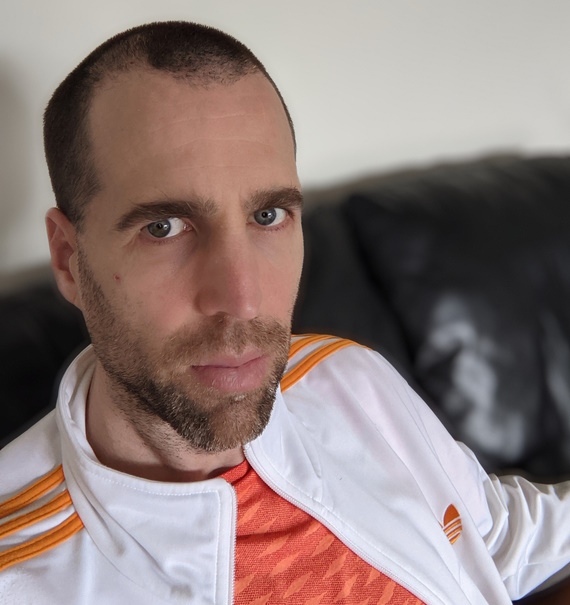
At the start of July, 2021, as a memento of this important turning point in my health, whereupon I knew that I was going to get better, I did something I never do: I took a selfie.
Vaccination Decision
It was around this time that I received word from my Mum that my Grandma, who was in an aged care facility in South Australia, was not doing so well, and was deteriorating fairly rapidly. I was really eager to see her one last time, since it had been about eighteen months since our last in-person get-together.
Of course, this was all occurring against a COVID backdrop, and the aged care home had strict vaccination requirements (they weren't using the product I had worked on at my previous employer, at least to my knowledge - that would have been the height of irony). Combine this with the fact that Delta was doing the rounds, and that I was well aware what the long-term implications of a respiratory virus could be (and had already heard about Long COVID, which sounded strikingly like CFS to me), and you can imagine why I was considering vaccination.
All the same, I didn't take the decision lightly. I deliberated for hours with Belinda as to whether I should get it or not, at the time only really concerned that it might be dangerous to me, given my history. Ultimately, we couldn't come to a decision, so I booked in to see my GP (the same one who had said I might have RA).
Before my appointment, I went searching for opinion to the contrary of the narrative, and found only the wildest of conspiracy theories, such as it being the coming on the anti-Christ, and Bill Gates injecting us with nanobots that would allow 5G towers to control us. Given that Bill Gates couldn't even produce a stable operating system, I was quick to dismiss these sources of information. Any signal was unfortunately lost in the noise.
I was quite naive of any censorship at this point, of which more later.
But I did hear whisperings of susceptibility for immuno-compromised folk, and although I didn't technically fit that category yet, it did strike me that my elevated RF and history of CFS would be enough to convince my GP that I should be granted an exemption. Boy, was I wrong.
My appointment, which lasted around fifteen minutes, was basically my GP insisting that I get vaccinated to protect myself, and that there was no risk whatsoever. He actually used my history as evidence for vaccination, and proclaimed that he himself was vaccinated and “was fine”, as though that should settle the argument (an argument I might have to try when my son's school complains about him having peanuts in his lunchbox).
Again, at this point I was completely naive to the possibility that the medical system itself was not acting in my best interest. After all, they swore an oath, and that means something to me.
That said, I don't entirely blame the GP. He is working within a system that has been commandeered and manipulated by industry, orchestrating and directing his path from the moment he stepped into university. The governing medical bodies - also funded by industry - assure him there is no reason to question their directives, and intentionally make him time-poor, limiting opportunity for inquiry and self-education.
I just wish I knew this then.
I left feeling dejected, but thinking I had done what I could to allay my concerns. Ignoring my gut feeling, I booked myself in for vaccination at a local hub.
The Injury
I received my first Comirnaty (Pfizer) inoculation (to use the term generously) on the 7th of July, 2021. I experienced excessive tiredness that night, but that was about it.
I was due for my second on the 29th of the same month, and in the interim I heard murmurings of the second shot being far more impactful on the body than the first. This concerned me primarily because it did not align with my expectations - it didn't seem logical. I made a mental note to ask about it before receiving my next jab.
On July 29th, I did exactly that, asking the administering nurse if people were reacting more strongly to the second shot and, if so, why that would make any sense - surely the first shot should cause more of a reaction? Indeed, that was the case with Astra Zeneca. The nurse agreed that it was indeed a strange phenomenon, but could not provide an explanation as to why. She even asked the nurse alongside her, who also did not know why.
Despite this, I received the shot.
My big mistake here was not having planned what to do in the event of receiving an unsatisfactory answer. I had planned to ask the question, but not what to do with the answer.
That night, I had the most intense fever I've ever experienced. I lay all night shaking uncontrollably, breathing rapidly, head pounding, wanting to leave the room to avoid disturbing Belinda, yet unable to gather the requisite energy. I did not sleep a wink. I constantly reminded myself of the current narrative: two shots and I'm immune to a deadly virus. Totally worth it, I told myself.
The following day, a Friday, I had already arranged to take off “just in case.” I'm glad I did because I finally fell asleep at around 9am and slept through until 3pm. I ate something, then went back to bed and slept right through until the next morning, where I awoke feeling sluggish. I had a lazy Saturday, another good night's sleep, then awoke on Sunday feeling significantly better. I figured I'd have another restful day to be sure I was good and ready for my usual routine on Monday.
It was now Monday the 2nd of August, 2021 and I got straight back into things, heading to the local aquatic center for my swim. I jumped into the pool as I always did, getting the cold shock out of the way. I felt somewhat lacking in energy, but figured I'd just go easy today - maybe 100m. I pushed out into my awkward breaststroke and made it barely a quarter of a lap before being overcome by debilitating fatigue. It was so intense I panicked a little, worried about drowning. I managed to grab onto the lane divider and rest a little. Then I slowly pulled myself back to the pool's edge. I was in a middle lane and couldn't muster the energy to make it to the ladders on either side, so I instead decided to pull myself out in the usual manner. My “usual manner” degraded into awkward inelegance as I found I didn't have sufficient energy to do anything but gracelessly roll myself out of the pool.
I sat at the edge for a minute or so, attempting to gather energy, and noticed my arms beginning to shake. I decided to just get home as soon as I could, so I made my way out and drove the short trip back, my arms shaking ever more violently along the way.
I made it home and immediately told Belinda what had happened. Within 20 minutes or so, my legs were also weak and shaking uncontrollably, to the point that I didn't feel safe standing. I rang my Mum in a panic, desperate for her to know what was happening to my body, but not lucid enough to have thought to record it.
My suspicion immediately went to B vitamins, since my naturopath had recently reduced my dose. Strangely, I didn't even consider the vaccine at this point - after all, I had been brainwashed into thinking it safe and effective, and I had ostensibly recovered from my weekend ordeal. I immediately took double the dose of B vitamins that I would ordinarily take, hoping against hope that the weakness and shaking would subside.
So began 6 months of hell on Earth. I don't say this lightly: I thought I was going to die.
To put it in perspective, I soon decided to write a farewell letter to Belinda and my family, leaving practical information and instructions for them in my passing. But all I could do was think about it - I couldn't muster the ability to actually do it until months later.
Weakness, fatigue, shaking, muscle twitching, loss of motor control, body rigidity, anxiety, depression, brain fog, bulging eyes, pressure around eyes and temple, bloodshot eyes, headaches, parasthesia, soft tissue pain, reflux, nausea, constipation, abdominal pain, low appetite, low libido, neck tension, blurred vision, blood noses, chest pain, tachycardia, bradycardia, dizziness, tinnitus, pulsatile tinnitus, bounding pulse, ear popping/pressure/pulling/clicking sensations, suicide ideation, dissociation, a heavy and swimmy head, swollen and tender feet, nervous system jolts and misfirings, involuntary movements, vibrating nerves, internal tremors. These were some of the describable symptoms.
Anyone who has suffered vaccine injury will know that much of the experience defies description. Symptoms are nebulous, ever-changing, and truly ineffable. Much of what you feel is simply not meant to be experienced by a human, so trying to describe it to someone else often feels like trying to describe what it would be like to see to someone who is born blind, or trying to imagine perceiving the world through the bio sonar senses of a bat, or a dolphin's echolocation.
One of the many pointless fantasies I returned to again and again throughout this whole ordeal was to be able to record what I was feeling, then play it back, directly into the nervous system, of my doctor. That was the only way I could imagine accurately conveying what I felt.
My life was horrible during this period, and I once again found solice in work. Just like all those years ago in banking, I found that by concentrating on work I was able to distract my mind from the barrage of symptoms. Looking back at my git log for that period (for the non-programmers, git is a tool that tracks all our code changes), I can see I did some really cool stuff. Once again, I feel like losing myself in work may have saved my bacon.
It may seem ironic that work helped me given that it had, in the recent past, been an instigator of health deterioration. The problem is that “work” is too broad a term to be helpful here. Some jobs come burdened with office politics, commute, dealing with certain egos and personalities, incompetent management, and downright foul play. In both this case and in the banking case, I was doing work that I genuinely enjoyed without any of the extraneous burden.
I think Gabor Maté says it best:
“The gods, we are taught, created humankind in their own image. Everyone has an urge to create. Its expression may flow through many channels: through writing, art or music, through the inventiveness of work or in any number of ways unique to all of us, whether it be cooking, gardening or the art of social discourse. The point is to honour the urge. To do so is healing for ourselves and for others; not to do so deadens our bodies and our spirits.”
- Gabor Maté, When the Body Says No
I was honouring my urge.
Realisation - Connecting the Dots
For a few weeks I was distracted by B vitamin and methylation/CFS considerations. I was looking everywhere except at the elephant in the room.
I finally came to the conclusion that it wasn't related to B vitamin deficiency or other things I'd lived with for years because my symptoms were just so aggressive, like nothing I'd ever experienced. And besides, I was back on my usual regimen and not seeing any improvement.
Suddenly, I realised I had been taking detailed notes - an absolute godsend when battling these kinds of symptoms because temporality and chronology become so distorted. I went to look at what happened when. I checked when the onset of weakness occurred - August 2nd, 2021. Then I looked at when I received my second Pfizer - July 29th, 2021.
It was so obvious. I had jumped into that pool just 4 days after my shot, thinking I had recovered, but the chill of the pool and exertion of swimming a few strokes has tipped my beaten body over a precipice.
I reported my injury to the Adverse Medicine Events Line (the Australian equivalent of VAERS) on the 13th of September, 2021. The lady I spoke to expressed sympathy, but offered no advice or hope. I asked whether reactions like mine were common and she talked around my question, saying only that she spoke to a small subset of callers and therefore was not in a position to make inferences. This, despite the fact that she was literally employed to help maintain the database that is supposed to answer that very question. I went digging myself at the time, since the database was queryable (back then it was glacially slow to access, but they seem to have improved the entire experience since then, perhaps due to increased demand). Indeed, I was seeing a concerning number of symptoms like mine.
For the fourth time since my injury, I went to see my new GP. I had switched to Belinda's GP because I didn't trust myself to be civil with my previous GP, who had been so insistent on me vaccinating. I explained the timeline to her and how I had connected the dots (using my detailed data). She accepted, in a very reluctant and roundabout way, that it could be related to the vaccine, but, in her words, I must have suffered a “very rare reaction.” I believed her, in part because it made me feel better about Belinda's vaccination as well as society at large, and in part because I felt my CFS had acted as an underlying catalyst for injury.
It turns out I was right to be wary of the vaccine on grounds of my long-standing ME/CFS. It has since come to light that many with ME/CFS have suffered as a result of vaccination. To be clear, I'm not saying it's “safe” to get these vaccinations if you don't have ME/CFS (read the article), only that it's definitely unsafe if you do.
It was September 14th, 2021 when I spoke with my naturopath about my injury. She immediately recognised my symptoms, and warned me that another shot would likely disable me (not that I was planning on one). This was based on several of her patients who were in various states of disablement, and her observations of patients worsening with each shot. I was shocked.
Along with my GP and naturopath, I continued seeing all manner of practitioners including a physio, a chiropractor, a remedial massage therapist, and a myotherapist. I actually changed GPs again because Belinda's GP had suggested seeing someone who better understood CFS. I found someone around an hour from where I live, which is considerably less convenient, but has turned out to be well worth the trip. I see him to this day.
It is my experience that medical doctors that acknowledge the missing elements of their medical training (e.g. nutrition and natural therapies) and understand the incentives of the system in which they operate, are better placed to help those with chronic illness. Even better are those medical doctors who are trained in such alternative modalities. This new GP of mine, along with doctors like Dr Tumi Johnson and Dr Mark Donahoe (just to name a couple), exemplify such doctors.
Months passed without any significant change in my symptomology. There was a slight trend towards improvement, but it felt glacially slow, as though my body was simply not getting what it needed to heal.
Throughout all this, I was continuing to search for other people like me. Time and again I came up empty-handed. For nearly an entire year, I reluctantly accepted that my injury must be rare.
And then things changed. First, I searched YouTube for the bazzilionth time. I believe my exact search term was “Pfizer twitching”, since muscle twitching was the one symptom that was with me 24/7. Up popped this short video by a guy called Nick Shulhin, who was likely recommended to me by the algorithm simply because, like me, he's a software engineer. Watching Nick's calf twitch exactly like mine confirmed my increasing suspicion that I can't be alone in this.
I spoke to Nick on September 6th, 2022. He'd had no success getting help, and his YouTube channel had been delisted since I found his video (that's a nice way of saying “censored”, since he was removed from search results). He has since gone on to help create Coverse, an Australian organisation to help the vaccine injured.
I also stumbled upon r/vaccinelonghaulers, a Reddit for vaccine injured folks. On it, I found countless examples of people suffering in myriad ways, with several patterns of symptomology. I was both relieved to find others like me, and distraught to feel my internal beliefs and hopes crumbling in the face of new evidence. No longer could I tell myself this was “just” a worsening of my CFS that I would eventually work through, nor that my family weren't being put at risk taking the vaccine, nor that the public messaging around the vaccine and virus was honest.
I want to be very clear here, because a lot of people - including me - fell for the false dichotomy the “health authorities” were presenting: get vaccinated with an mRNA vaccine or get COVID, with the very real risk of developing Long COVID. I'd have greatly preferred neither, but wasn't sufficiently astute to see that as a possibility.
To this day, this subreddit has been “quarantined”, which is again a nice way of saying “censored.”
I am Extra-Bat2248 on Reddit. This name was auto-generated for me when I signed up - it's not COVID-related at all, but amusingly apropos.
Path of Recovery (so far)
My recovery, although incomplete, has come a long way. It has occurred in stages.
Around 3 months into my ordeal - still in the midst of the abysmal stage 1 - the naturopath I was seeing wanted me to rule out mould as a possible cause of my woes.
This particular naturopath was excellent. She was thorough and avoided jumping to conclusions based on her own experiences.
However, one of the problems with chronic illnesses is that the symptomology can be so broad and overlapping that every practitioner you see will likely relate to some subset of those symptoms, and attribute it to the thing they're most experienced in (very often from their own personal experience, which is often what prompted them to become a practitioner in the first place). This has actually been the primary beef I've had with alternative, non-mainstream treatment. One has to learn to see the situation through this lens and adjust accordingly.
Another annoyance is the tendency for naturopaths to want you on their supplement line. No doubt this is mostly to avoid them needing to do extra work to understand your existing regimen and to be sure you're taking only what they understand, but there's also often a financial incentive for them to do so, which I find distasteful.
It took a while to get a qualified building biologist out to inspect our house (she came out January 6th, 2022), but it was absolutely worth it. She found black mould in the split system air conditioner that was adjacent to my bedside, as well as a particularly nasty species of white mould on my bedside table, which sat not half a metre from my head when I slept!
I immediately wrapped the air conditioner in black plastic and threw the bedside table out. And just like that, I moved from phase 1 to phase 2 of my healing journey. No longer did I wake up with nose bleeds and bloodshot eyes. But even better, some of the most awful nighttime neurological symptoms I was experiencing resolved. They were all symptoms that I find impossible to put into words, for reasons discussed above. Were I forced at gunpoint to describe them, I'd say they were worse than being held at gunpoint.
This is a good example of the cumulative nature of stress. Clearly, the mould didn't spring into existence when I got the vaccine - it would have been there for months beforehand. But it wasn't until my body was sufficiently overwhelmed with other stressors that the burden of mould toxicity manifested as symptoms. Up until that point, the presence of mould whilst sleeping would certainly have been having some negative impact on my health, but it just wasn't enough to instigate symptoms.
Mind you, I was still in a really bad state, but I finally detected gradual improvement. Not on a day-by-day basis, due to the ebb and flow of symptoms, but certainly month-by-month. Weather versus climate is a good metaphor for this: weather fluctuates within a range that is governed by the more slowly moving climate. My climate was trending upwards, but my weather was all over the place.
Importantly, I improved enough that I noticed an increasing contrast between my day-time symptoms and night. Every evening, like clockwork, my symptoms would ramp up - muscle twitching becoming more aggressive and moving up my body, parasthesia and jittery shortness of breath setting in etc. And every week or so I'd have a particularly bad night, nausea and reflux keeping me awake most of the night, along with nervous system jolts (including hypnic jerks and involuntary movements like my arm shooting straight up while I slept, waking me during the fall).
I referred to these nights as “regressions”, and began tracking them as such in Bearable. Instinctively, they seemed highly relevant to me.
Around May 2022 I found that I wasn't improving any further. My body felt stuck, unable to heal further. I continued seeking answers from practitioners, and trying various supplements and therapies, all to little effect.
It was also at this time that I became aware of the FLCCC and their protocols, including the I-RECOVER protocol for vaccine injury. Having listened several times to Dr Paul Marik and Dr Pierre Kory talk about the vaccines and pandemic in general, I had already developed a great deal of trust in them and knew I wanted to try this protocol.
One of the first-line therapies in the I-RECOVER protocol is Ivermectin. Delving into the story behind that drug - simply because I was trying to figure out how I could try it - began truly opening my eyes to the egregious overreach of government and “health authorities”, the propaganda they were spreading, and the death they fostered. To this day, many folks think of Ivermectin as something given solely to animals for de-worming purposes, which speaks to the efficacy of their slanderous campaign. Vitamin D received similar treatment, along with Hydroxychloroqine.
Why? Probably because in order for the vaccines to qualify for emergency use authorisation, there needed to be no viable alternative to them. Therefore, all such alternatives were mercilessly restricted, regulated, and attacked with blatantly cooked “science”, all funded by Pharma of course.
Thanks to Australia's Therapeutic Goods Administration (TGA), I had to order Ivermectin from overseas, putting myself at far higher risk than had I been able to obtain it via my GP. Their reasons for doing so are so transparently thin and ironic, they ought to be embarrassed.
Just a couple of days ago at time of writing this, the TGA have removed their restrictions on Ivermectin.
It wasn't until September 28th, 2022, that I finally had everything I needed to undertake the I-RECOVER protocol. This was 14 months after my injury.
I did version 3 of the protocol, dated August 3rd, 2022. They've since updated it and don't even seem to give a specific version number any more. The main thing they've added that I haven't tried is Methylene Blue. I'm in discussions with my GP about this, but it again appears to be something I'll have to source from overseas.
I started the Ivermectin ahead of everything else, mainly because I didn't want to confuse matters. I had warned Belinda to keep close watch on me in case I needed to be rushed to hospital, not because I believed the propaganda, but because I had ordered them from a random chemist across the other side of the world.
Not only did I not need the hospital, my entire body had transformed within 2 hours of my first dose. It was just incredible - the closest feeling I could imagine to Asterix drinking his magic potion. All my symptoms simply evaporated, including my blurry vision, heavy-headedness, and all the clicking and popping and full-body rigidity I was experiencing at the time.
My heart, which had been all over the shop since the vaccine, immediately settled. Take a look at how my average heart rate changed (via my Oura ring, which I unfortunately purchased several months after my injury because I was desperate for data confirming how bad my sleep and heart was):

As you can see, my average heart rate falls off a precipice as soon as I started Ivermectin. It was such a relief.
After starting Ivermectin, I had 5 days straight of pure bliss. I was completely symptom free, full of energy, and sleeping like a log. I did all sorts of things around the house, including cleaning all our gutters (something I had been wanting to do for ages but could never muster the energy). I was certain I had finally found a solution and could move past this horrible chapter of my life.
And then, seemingly out of nowhere, I had another regression. I was initially devastated, but also encouraged by the clear evidence that my body was capable of feeling good and that I had nothing structurally wrong with me (my blurry vision suddenly becoming clear was particularly relieving).
I saw out the entire first-line therapies in the I-RECOVER protocol, finishing up on the 23rd of November, 2022.
Another clear indication of my poor health throughout this ordeal was/is my HRV. At my worst points, I was averaging 13ms or so, once as low as 7ms. Even though I didn't have a baseline because I had never measured it prior to my injury, I could simply feel that it wasn't right. Whilst interpretation of HRV is highly personal, you can compare yourself to population ranges for your age and gender, and mine was distressingly low.
However, the I-RECOVER protocol also helped greatly in that regard:
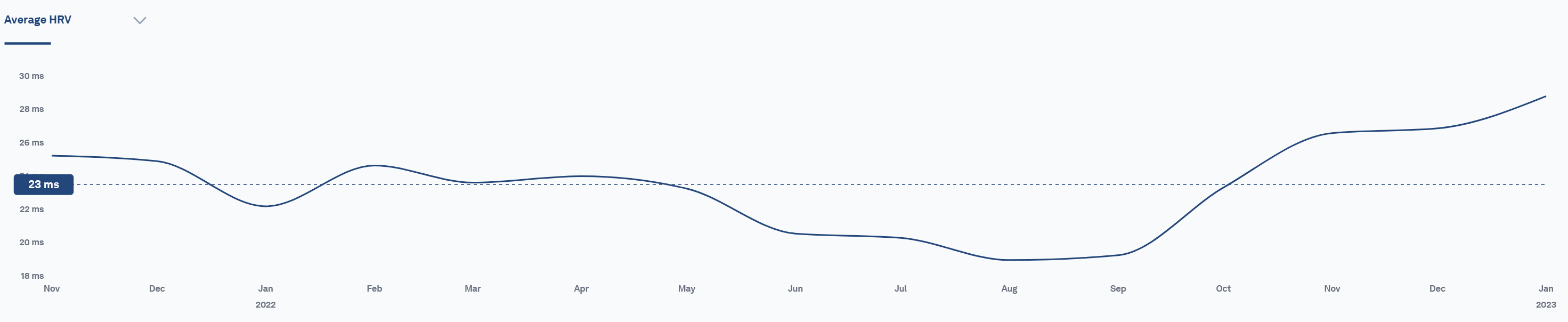
Although my regressions continued to occur roughly once a week, they were becoming less pronounced. Since completing the I-RECOVER protocol, I have recorded 10 more regressions, the last one being on December 31st, 2022. Any regression since then has been so mild as to be barely detectable.
For several months following the protocol, I felt as though I was making slow but steady improvement - nothing like the 5 days of bliss I had experienced at the start; rather, edging bit by bit towards a better state of health. However, I once again plateaued, my body seemingly unable to make further healing progress. I was happy to be stuck in a better place than I was last time, but still frustrated to be stagnant.
Since then, I have continued seeing various specialists, tried myriad supplements, and several therapies.
Theory, and Hopeful Path to Full Recovery
Over the decades of my health journey, I've come across an endless array of theories and suggestions for what might be ailing me. More recently, I've started connecting dots between some of these concepts. There is one in particular that I somehow had never heard of until recently, but before I get to that…
Back in 2015, I was seeing a counterstrain physical therapist in Adelaide. After several visits, receiving his treatment and chatting to him about my symptoms, he mentioned that he thinks I might be “sympathetic dominant.” He explained briefly what it meant - that my autonomic nervous system was having trouble switching out of fight-or-flight mode (sympathetic) back to rest-and-digest mode (parasympathetic). I made a mental note to look into it more (see the section on ironies below for how that turned out).
Another term I kept coming across more and more in my research was “dysautonomia.” This is a general term encapsulating problems with the autonomic nervous system. I could long relate to some manifestations of it - fatigue in particular - but it wasn't until my vaccine injury that I really became afflicted with it, leading to a whole constellation of horrible symptoms (many mentioned earlier in the post).
One excellent practitioner I was seeing - Dr Jeffrey Hannah - decided to leave Australia (also “thanks” to the TGA). Before leaving, he made sure he had someone to take over his practice. As an incentive for existing clients to continue receiving care under the new owner, a free session was offered on a mystery device that could really help some patients. That device turned out to be a NeuroInfiniti, which essentially measures fitness of the autonomic nervous system.
I don't mind sharing the relevant part of my results with you:
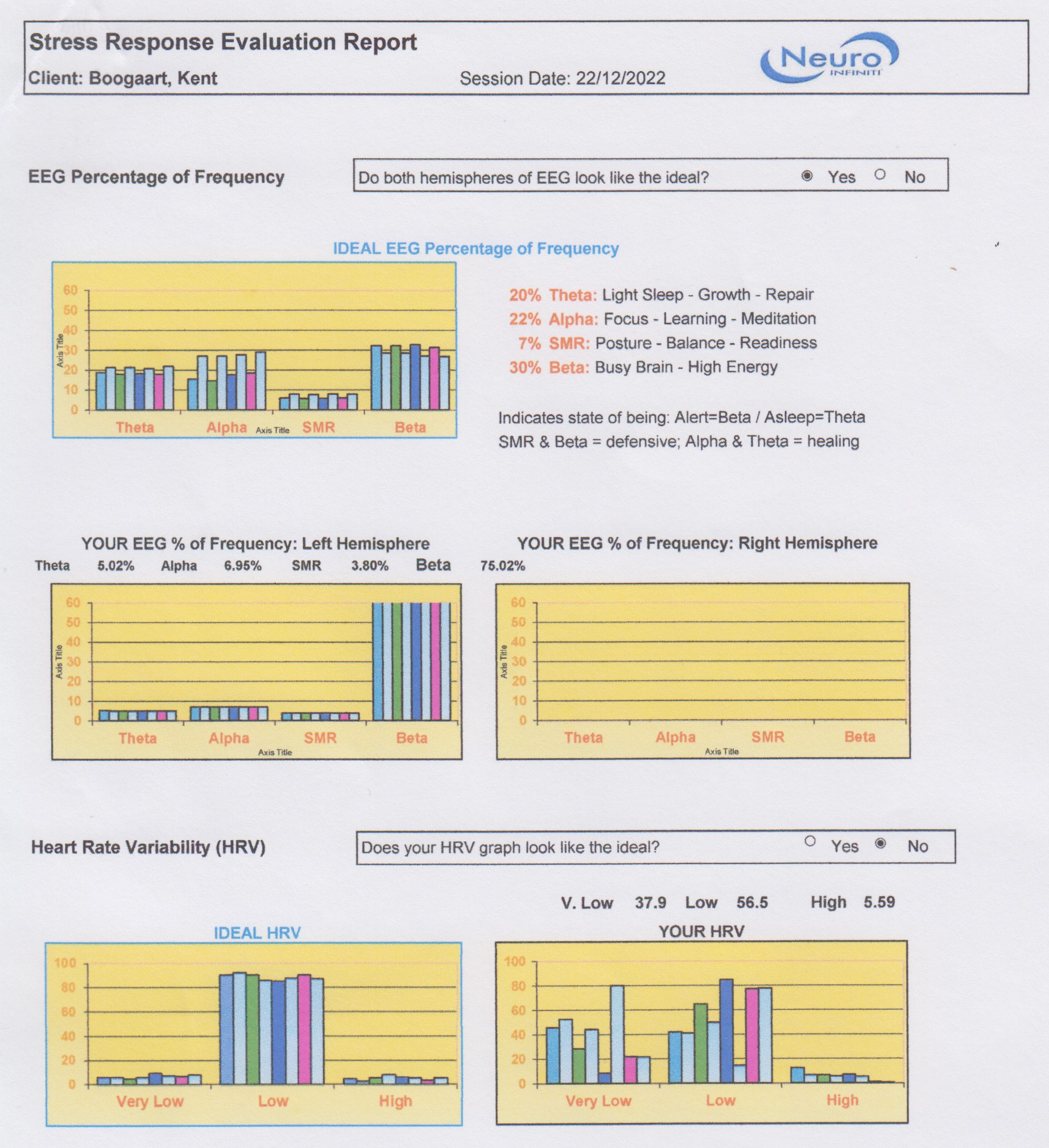
NOTE: one of the connections wasn't working, hence the "right hemisphere" is blank. Also, note the date of the test - this was when I was comparatively well.
Quick interpretation: my autonomic nervous system was utterly busted. I was completely beta-wave dominant and unable to switch into a parasympathetic state. My HRV is chaotic, also indicative of poor vagal tone. Although I already felt like my nervous system was struggling, it was good to have validation. And in case you're a little skeptical about the validity of the device, Belinda was tested at the same time and came out fine.
Another factor that is becoming increasingly difficult to dismiss is that of my personality. My research was repeatedly showing that type A personalities (achievement-oriented, competitive, fast-paced, impatient), perfectionists, those prone to catastrophism, people-pleasers etc. are more susceptible to these kinds of chronic health problems, which can then lead to autoimmune disease, for example.
“Limbic system impairment” is another relatable term I've recently discovered. It's basically the primitive part of the human brain going haywire, such that it detects threats where there are none. It's doing so in an attempt to protect you, but it can result in far too much time spent in a sympathetic state. Moreover, it can trigger a kind of feedback loop where heightened sensitivity leads to increased sympathetic state, which leads to reduced resilience, leading to even greater sensitivity.
Whilst I could absolutely relate to all these things, I was having trouble bringing them all together in a way that would explain my health challenges and identify a root cause. More importantly, it was very difficult to figure out what to do with this information. How could I actually get my body out of a persistent fight-or-flight? No amount of meditation, breathing/relaxation techniques, stress avoidance, hot baths, saunas, cold water therapy, yoga, sun exposure, grounding, nutritional changes, EMF reduction, or anything else seemed to move the needle much. They all certainly seemed to help at least a little, but most were very small gains.
Quite recently, I came across yet another term I'd somehow managed to avoid all these years: TMS. At first, I had trouble even finding a definition for it. Then I saw something that made it sound like it was just related to back pain, and almost completely dismissed it. But something drove me to dig a little deeper, and boy, am I glad I did.
TMS has a somewhat complicated history. Dr John E Sarno coined the abbreviation originally to mean “Tension Myositis Syndrome”, but he then broadened it to “Tension Myoneural Syndrome”, and then again to “The Mindbody Syndrome.” The basic premise is that the brain triggers physical symptoms in an effort to keep certain emotions suppressed, thinking it's in your best interests to do so (i.e. it's better to feel pain than deal with certain emotions).
Sympathetic dominance, dysautonomia, limbic system impairment, TMS, FND, Long COVID, ME/CFS. To me, all these things seem closely related and intertwined, and the research is bearing that out. My money is on them all sharing the same underlying physiology.
If you're at all skeptical, join the club! My initial thinking was that sure, this may be the explanation for some people, but there's simply no way that it could explain the horrendous physical symptoms and measurable immune and neurological system dysregulation of my own experience.
However, various things I was reading about TMS were resonating so strongly with me that I decided to keep digging. I am now at the point - having read part of Kevin Martillo's The Mindbody Syndrome: A Path to Recovery & Freedom, listened to all of Sarno's Healing Back Pain and The Divided Mind, and performed a bunch of research into my own symptoms - that I am as certain as I can be that I have been suffering from TMS all these years, even if the vaccine injury itself is distinct from it.
Symptoms I never even mentioned above - like waking in the dead of night with intensely painful cramps in my calves, or seemingly innocuous movements causing muscles in my back to suddenly spasming in crippling pain - suddenly made sense in light of TMS. These are things I had been experiencing on and off for years, but always viewed them in isolation, not connected to each other, let alone connected to my other CFS symptoms.
As for my worsening in the evening, I have two theories around why this might be so. Firstly, immune system activity increases at night, so to the extent that my immune system dysregulation is responsible for my symptoms, it would make some sense that those symptoms increase in lockstep with immune system activity. Secondly, the horrific fever I had the night of my second dose may have engraved a negative association with night (or being in bed) into the associative pathways of my brain. That is, my amygdala may be thinking it's doing me a favour by instigating all these symptoms, in the hopes that I move away from the situation.
I don't want to write much more about this until I've had sufficient time to pursue TMS recovery techniques. For now, I will simply state that I have begun implementing some of the recovery techniques and am already seeing some changes.
As mentioned in the introduction, I will post updates with more information on my recovery - whether positive or not - at relevant points in the future.
I've also learned that some people are known as HSPs (highly sensitive persons), and there's no doubt in my mind that I am one. We are the canaries in the coal mine, and society would do well to take heed of how we react to the increasingly toxic environment we all inhabit.
Here's a great Podcast that touches on this and more.
What Has Been Found
Firstly, I want to be clear that the absence of evidence for symptoms is not evidence for the absence of symptoms. It sounds so obvious, but I find it utterly baffling that so many medical doctors seemingly think that we've attained such a comprehensive understanding of the human body - the most complicated system in the known universe - that we can measure everything within it. Even at face value, this is an absurd belief, but it is an especially confounding position to entertain in the face of so much COVID novelty, both in the virus itself and the so-called vaccines.
That said, my GP (the good one who has a history of treating CFS patients) already had several vaccine-injured patients by the time I saw him, and knew there was a good chance of certain biomarkers being abnormal. Indeed, he immediately ordered C3 and C4 (immune system markers) tests and found mine to be irregular. They remain irregular to this day, but have been slowly improving each time they've been tested. This is consistent with me feeling a bit better over time, so hopefully they're indicative of gradual healing.
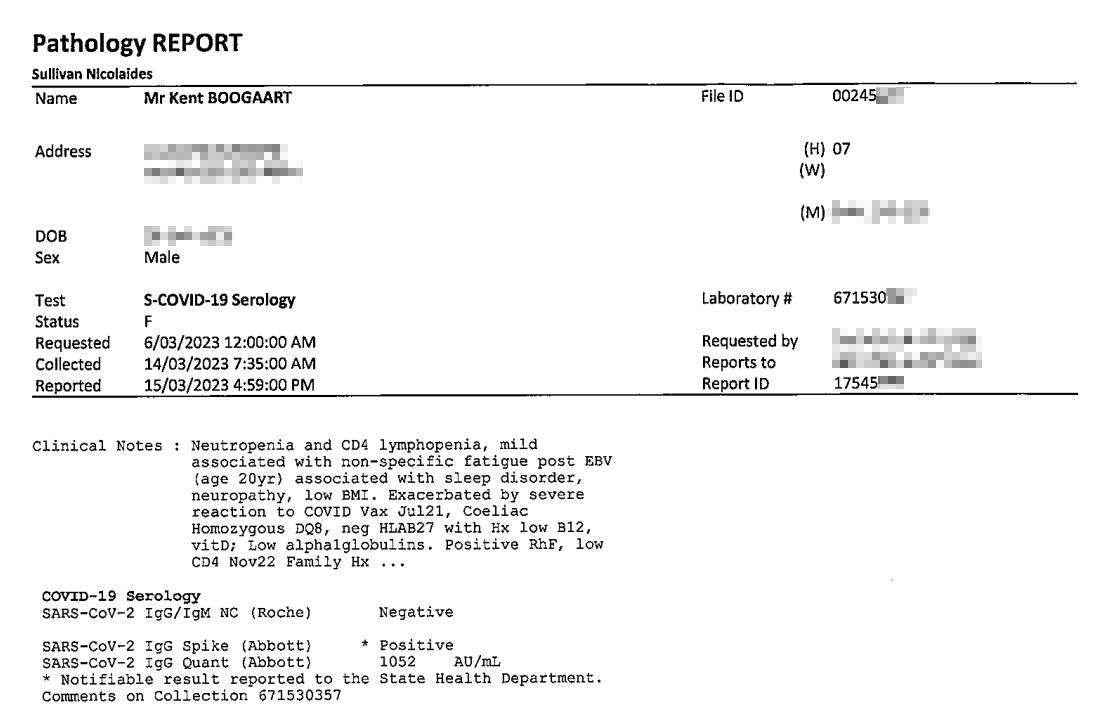
On top of that, my haemotologist has found my bicarbonate levels to be on the high side, which I think is indicative of metabolic alkalosis. It's unclear to me if and how this is related to the vaccine. She also ran SARS-CoV-2 IgG/IgM tests to determine whether I've had COVID, or am only showing evidence of vaccination. As I suspected, it appears I've never had COVID:
I've also had a tilt table test, which was aborted at minute 12 when my BP dropped to 50/40:
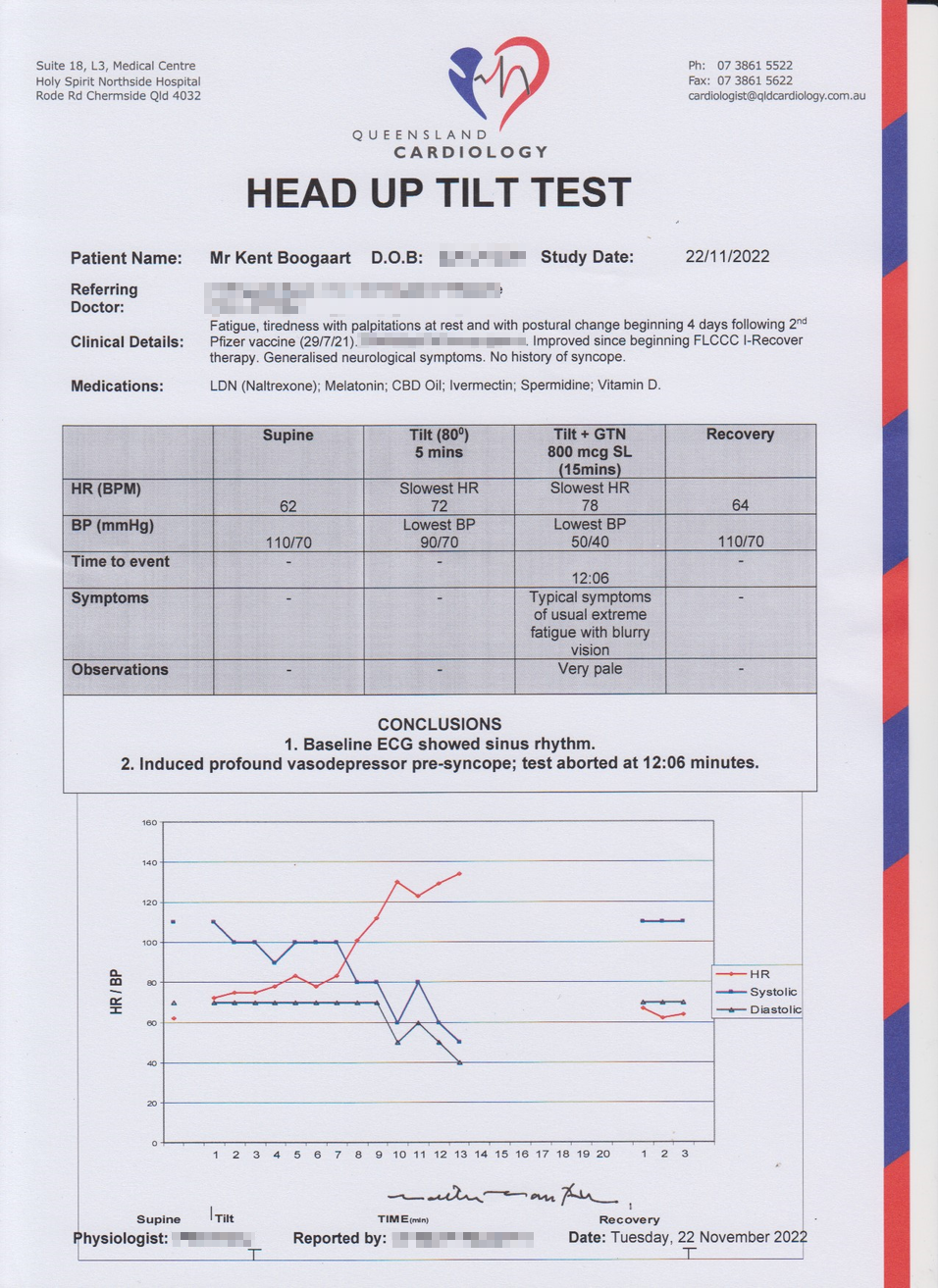
Outside of medical tests, which I've come to realise are often of dubious value (e.g. serum levels being the last thing to fall out of balance, yet the easiest thing to measure), I've had a couple of less “accepted” tests (in Australia, at least) show significant disruption in my nervous system. One of these was the NeuroInfiniti, which I shared above. Another was an electrodermal screening test (a.k.a. galvanic skin test), which is apparently used a lot in Europe:
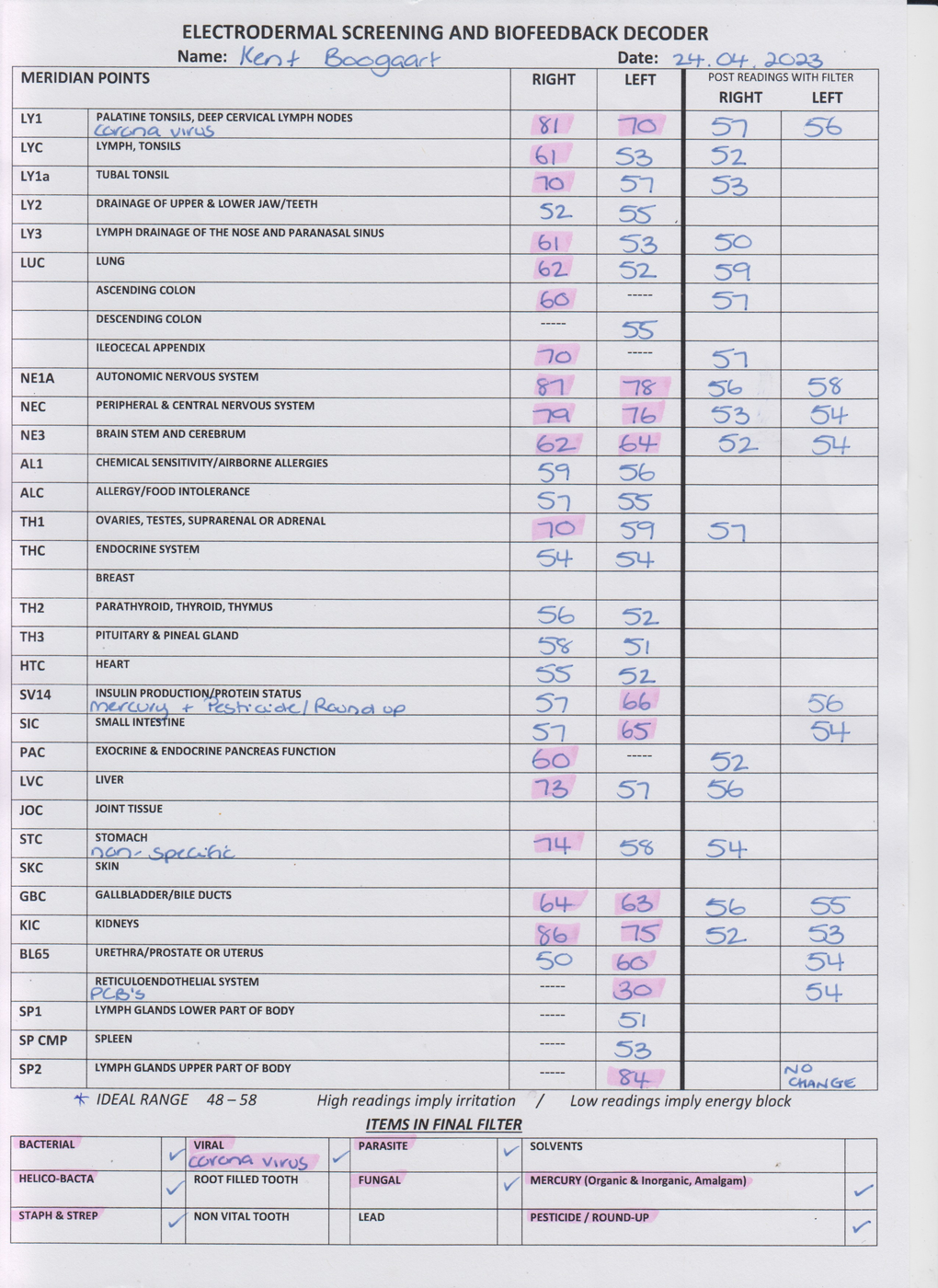
How I'm Feeling Now
Probably around 80% recovered. That is, recovered to where I was just prior to my second vaccination. I still have incessant muscle twitching and tinnitus, and often have blurry vision and low energy/fatigue. It is difficult to discern, however, how much is true recovery versus making more and more accommodations for my new norm. I suspect were I to undertake anything particularly stressful, I'd regress quite rapidly.
The pattern of feeling worse at night continues to this day, with several symptoms I don't get during the day coming on at night (like bounding pulse, weird vibrating nerves, and pressure around the eyes and temples). That said, my nights are generally bearable. Indeed, just last week I had the first sleep since taking Ivermectin where I felt some genuine restoration upon waking. Hopefully that's a sign of things to come.
My current understanding of the root cause here is that of nervous system dysfunction. I seem to be stuck in either freeze or fight/flight mode, neither of which is conducive to healing or good health. From what I can tell, being stuck in such a state sufficiently explains all my symptoms (including immune system dysregulation) and aligns with my experiences.
My plan for healing, then, is to coax my nervous system back to homeostasis. This has been harder than I'd like, and not just a matter of performing the various vagal exercises you'll find via a Google search. However, my discovery of TMS has made it clear that emotional repression can also be a factor. I've already seen some improvement and shifts in my body since beginning TMS training, which is encouraging. I think a big component for me will be psychotherapy, which I have only just started.
What about COVID?
The obvious irony is that I've felt far more susceptible to COVID since receiving these “vaccines” than I did prior. I desperately want to avoid getting it because I don't think I'll do well, and my haemotologist agrees.
My plan has been to avoid crowded spaces wherever practical, and to rinse my mouth and nasal cavity with 1% povidone iodine solution when I can't. On top of that, I have a stack of Ivermectin and Hydroxychloroqine on standby, and have been supplementing with Vitamin D, C, Magnesium Glycinate, Zinc, Glutathione, and a bunch of other nutrients.
How this has Impacted Me
This entire experience has upended my world several times over.
What trust I had in the society and institutions I helped to build and fund through my tax dollars has evaporated. There seems no end to the lies I've been told, and continue to be fed. And when reality is evitably incongruent with those lies, I'm told that my reality is not true. That my very experience is somehow not valid.
The medical system, in which I still retained some semblance of trust, has completely lost that trust. It is distressing and disturbing to me that the very people sworn to look out for the individual's health are not only failing to do so, but are making matters worse by gaslighting and refusing to speak up against the narrative - or even actively support it! There are some brave few, of course, and I am extremely grateful to these heroes, but there should be more; far more.
The wider medical edifice has lost all credibility, thanks to it slandering and defrauding of viable, safe treatments, not to mention the corruption of supposed medical journals. It's all just a puppet for pharma.
My belief that people are fundamentally good, and good to each other, has been disturbingly challenged. I have witnessed the very worst of human behaviour. Many of the vaccinated mock the injured, perhaps as a kind of psychological coping mechanism, and many unvaccinated attack us, claiming we deserve it for the way they were treated by society when they chose not to vaccinate (which was itself a reprehensible situation).
Thankfully, I have also experienced the very best of human behaviour. The vaccine injured community are incredible, supporting each other through the direst of circumstances. I have personally met some wonderful people in this community, and feel richer for having done so.
Then there are those inspirational people fighting for the liberation of truth and application of justice, such as Bret Weinstein and Heather Heying, Del Bigtree, Dr John Campbell. Dr Joseph Mercola, and Steve Kirsch. And I want to give a special shoutout to Dr Melissa McCann, who is spearheading the class action against the TGA. Even though it came too late for me, I am so grateful to have discovered these folks and to benefit from their courage and insight.
What slim hope I had that the mainstream media were impartial has been completely obliterated. It is now abundantly clear that they have merely supported the narrative, never saying a word that might result in funding cuts.
My distaste for politicians and our political system has amplified manyfold. I have long been dissatisfied with our flavour of democracy, annoyed that we as a society seem to have settled on “good enough” and “at least it isn't communism,” unwilling to explore the potential for incremental improvement, as though to admit imperfection is to denounce democracy as a whole. And now, especially in the US but also in Australia and the UK, it is clear that our political systems are rife with corruption and absolutely require such incremental improvements to re-establish and protect democracy.
Politics has become a team sport for so many citizens, blinding them to the reality that there are no teams worth barracking for. Division is a catalyst for this, hence the continual politicizing of apolitical issues, and the abandonment of nuance and rational discourse. It has been absolutely soul-destroying to witness the bifurcation of society and the rampant binary bias, all whilst in desperate need of acknowledgement and help. To have people openly arguing that the injured don't exist or that, even if we do, we are a price worth paying, is the very antithesis of society.
On top of the emotional toll, there has of course been financial impact. I've been very fortunate to have worked throughout this ordeal, only possible because I have a cognitive job and work from home. Were there any significant physical requirements - even commuting to an office - I'd have been unable to work at least for the first 6 months or so. Even so, I've poured tens of thousands of dollars into my recovery. Dozens of doctor and specialist appointments, expensive therapies, buckets of supplements, and zero compromise on nutrition. All these things intended to alleviate stress and promote healing ironically add a ton of financial stress, and you can imagine how much compensation I've received from the government that insisted that this was “safe and effective.”
On top of this, I've had to put all extracurricular activity on hold. I've barely touched any of my open source projects in years, have had to say no to additional contracting opportunities, and have delayed the second edition of my book, which I had intended to write in 2021/2022.
And yet, despite all this, I'm grateful for the life experience, the lessons I've learned.
Lessons Learned
“That which is growing looks only ahead; that which is declining looks only behind.”
- Dee Hock
The key takeaway I have from this experience is to take responsibility for my own health. A belief and trust in specialisation encouraged me to outsource as much of my life as possible so that I could concentrate on becoming better at the skills I am paid for as a software engineer. This resulted in a lack of key knowledge and instinct with respect to my own health, and a willingness to put my health into someone else's hands. Specialisation is inevitable, but I must learn to look at it as a spectrum, otherwise it is overly predicated on trust.
The multifaceted nature of stress, and its nuanced interplay with DNA and personality, make it abundantly clear to me that “safe and effective” should never have been stated categorically; it's an outright lie. It makes as much sense as saying penicillin is safe for all, or even peanuts. It's also clear that each shot you take is an additional stress on your body.
The purpose of me detailing my own personal stressful life events - apart from the inherent therapeutic value - is to drive home the point that all stress experienced by an individual is inevitably related and intertwined, whether it is physical, emotional, environmental, or whatever. An accumulation of stress to the point of distress is possible for anyone. If you've been injured by these injections, I'd encourage you to ponder your wider circumstances and potential for having exceeded your body's natural stress tolerance, thereby pushing your nervous system into a state of hyper-arousal and dysregulation.
Irrespective of whether these shots are intended to erode the population's health (and I'm refraining from a tangential discussion on fluoridated municipal water, official food and nutritional guidelines that are quite literally upside down, the abundance and ostensible affordability of processed “foods”, pesticides in our food supply, WiFi towers and EMF, dental amalgams, inadequate building codes that foster mould growth etc), it is abundantly clear from studies like this Cleveland Clinic one that they do. Regardless of your personal capacity for stress, it isn't infinite, so each shot you take is an additional risk. Even if these “vaccines” actually worked, it would still be a risk - it's just a matter of whether that risk is worth it with respect to available alternatives.
Related to this, I need to trust my gut. Not for the first time, overriding my gut feeling is what got me into this mess. Time and again this has happened, yet I neglected to take the time to retrospect and analyse. When I did, I realised I did so because I had literally lost trust in my gut after years of CFS-related GI symptoms, but also because I fundamentally did not accept the gut to be an important input to the decision-making process - the result was that I thought of my gut as an annoying limitation of my physiology rather than something worth paying attention to. I have since learnt much about its complexities, that it is known as the “second brain” for good reason, and that it is there to help me. Just off the top of my head, I can list half a dozen significant decisions I have made in the fairly recent past that went against my gut and ended badly, vaccination being the biggest of those.
Another important lesson is that the backbone institutions of society are far more corrupt and dysfunctional than I could have imagined just a few years ago. From media to medicine, pharma to politics - all have colluded and misled the public, and continue to do so. Perhaps most confronting to me was the role of big tech, especially in its willingness to censor based on government directives.
I am not claiming that all individuals working for these institutions are themselves corrupt or malevolent. In fact, I'd say most are really good people doing the best they can to help others. What I am saying is that these people are working within a system that redefines “good” and “bad” according to its own agenda, then convinces said people of those definitions through whatever means necessary.
Even science itself has been corrupted and perverted. There have been revelations of cooked studies funded by those with vested interests, failings of the oft-revered peer review process, and double-standards that conveniently allow only big pharma to play the game. And with oxymoronic utterances like “trust the science” being accepted and parroted by large numbers of the general public, it's clear that the manufactured polarization has resulted in many laypeople doing unpaid work for pharma. Critical thinking has evaporated. It's as though people are awaiting the results of the randomised control test on common sense before they're willing to employ it.
It has been confronting to observe that empathy is far too lacking in our society. People seem increasingly incapable of putting themselves in another's shoes, all too eager to denigrate and dismiss, often in the hopes of a few “likes”, or perhaps to ease their own cognitive dissonance. It is my firm belief that empathy is the fabric of society, and that its decline is in no one's interest. Bear in mind that my injury is relatively tame compared to others'. Many folks are suffering more severe symptoms, have lost their income, their houses, their relationships, and more. These people need help, and it starts with empathy.
At times, I have felt incredibly foolish looking back at this experience, but I'm determined to overcome that feeling. Are you foolish if - knowing nothing about cars - you purchase a car after having it checked over multiple times by ostensibly independent and expert parties, only to discover it's a lemon? Naive or ignorant, yes, but not foolish. We are all naive and ignorant about many things, but life circumstances or sheer luck often shields us from any repercussions of that ignorance, great or small. Just occasionally, our ignorance and circumstances align in such a way as to present a costly life lesson. It's a fool that ignores the lesson.
What surprises me most is that I feel a strong sense of gratitude for this experience. Without it, I wouldn't have slowed down to smell the roses, wouldn't have learnt so much about health, wouldn't have developed the keener sense of distrust in the institutions that have failed us (this might sound like a bad thing, but I consider it a boon for the purposes of future decision-making), wouldn't have met some of the great people in the vaccine injured community, and I wouldn't have grown in appreciation for my own body's resilience. I plan on this experience being foundational to my coming decades of thriving health and wellbeing.
Ironies
When first setting about writing this account, I considered taking a comedic tone, but painting such dire subject matter with humour seemed impossible and inappropriate, and certainly beyond my abilities as a writer. I did, however, decide to make note of some of the fantastic ironies I happened upon throughout my journey. They don't necessarily make me laugh out loud yet, but I think in time they may.
The first I have already alluded to: the commitment I made to pursuing “perfect” health just 6 months prior to my vaccination. By the point of vaccination, my focus had been on collecting health data on myself using Bearable (which I intended to use to spot patterns and make informed decisions). I was also compiling a list of books, blogs, YouTube channels, and podcasts that I was going to consume in my journey. Had I made this commitment just a month or two earlier, I'd have had enough time to work my way through some of the resources I was amassing rather than just collecting data on myself. Even a few episodes into Dr Ron Ehrlich's Unstress podcast, for example, I was learning things that would have steered me in the right direction.
Not a week after my onset of stress-induced RA-like symptoms back in 2021, I remembered my Adelaide GP (the one who diagnosed me with CFS) warning me to avoid stress. Months and months of incessant stress didn't remind me, but as soon as I jumped out of the pan (and into the fire) it returned to me like I'd had the conversation yesterday.
In searching for answers to my post-vaccination health woes, I was researching something called “sympathetic dominance,” since it aligned so neatly with my experience. Intrigued, I looked for books on the topic and found one called SD Protocol (by Dr Wayne Todd). I went to buy it on Amazon, but was confused by the absence of the familiar, yellow purchase button. After a few minutes of frustration, I saw a subtle message telling me I already owned the book on Kindle. Confused, I went to check my Kindle. Sure enough, there it was. I had purchased it way back in 2015 when my Adelaide counterstrain physio had suggested I might be sympathetic dominant. I had just neglected to read it.
After educating myself about Ivermectin, I was certain I wanted to try it, but had no idea how I could due to the Australian government restricting its access. In desperation, I considered travelling overseas, despite my health. I asked my employer, who operate in Bangladesh, what the COVID situation is like over there and whether Ivermectin is available. Not only was COVID a non-issue over there, and not only is Ivermectin readily available, but my employer themselves sell it! Yeah, if I was in Bangladesh I could use my employer's very own public website to order the drug I so desperately needed. They tried sending me some, but it got turned back at customs. I ended up receiving some from India, as mentioned.
The Musk acquisition of Twitter is so conflicting and ironic for me. I cannot stand the man, and yet he has given a voice to the vaccine injured and to the doctors who were de-platformed as a result of not parroting the narrative. Regardless of all his faults, I am grateful that someone has allowed the conversation to occur in a public space.
Resources
Below are some resources that have helped me immensely, both in terms of improving my general health knowledge, and in understanding the nature of the COVID response.
Books
- The Body Keeps the Score (Bessel van der Kolk)
- When the Body Says No (Gabor Maté)
- Turtles All the Way Down (anonymous authors)
- A Life Less Stressed (Dr Ron Ehrlich)
- Any and all of Dr John E. Sarno's work
- Your Brain is Always Listening (Dr Daniel G Amen)
- Break the Mold (Dr Jill Crista)
- Healthy Home, Healthy Family (Nicole Bijlsma)
Podcasts/Vodcasts
- Darkhorse (Dr Bret Weinstein and Dr Heather Heying)
- Unstress (Dr Ron Ehrlich)
- The Doctor's Farmacy (Dr Mark Hyman)
- The Human Upgrade (Dave Asprey)
- The Energy Blueprint (Ari Whitten)
- Dearly Discarded (Jared St Clair)
- Dr John Campbell
- The Highwire (Del Bigtree)
- Club Grubbery (Graham Hood and John Larter)